Here are ten of my favorite reads from 2023. They’ll take you from ancient Canaan to galaxy’s far away and long ago. Five of these books are fiction, and five are non-fiction. There is an emphasis on ancient religion in the latter—but ancient religion is fascinating, especially when many of us claim to still follow its “unchanging” truths in the present. Anyway, here’s my list.
Fiction
 David Copperfield (Charles Dickens) and Demon Copperhead (Barbara Kingsolver). Irene and I listened to these two books on our winter drive from Kingston, Ontario to Florida and then California. Demon Copperhead was inspired by Dickens, so we listened to an abridged version of that first. And then Kingsolver’s book.
Both were fantastic. The narrative voice in Demon Copperhead, in particular, is unforgettable. Demon is a character you will fall in love with as he falls in and out of trouble—but never drowns.
The Promise (Damon Gadget). I’ve read several books, both fiction and nonfiction, about South Africa this year, partly because I’m writing my own novel set there (be patient; it’s coming!).
This one, full of the rusty sepia tones of my own ethnic and religious upbringing, was remarkable for . . . well, the promise and one person’s insistence that it mattered. Without making it the core of the story, this novel also illuminates the multiple realities of contemporary South Africa.
Americanah (Chimamanda Ngozi Adichie). So, you think moving from Nigeria to the West would be just the thing? Why? What really matters in life? Do we have it here? Among the topics Adichie explores are race (especially what it is to discover you’re black), class, education, poverty, corruption, and family. The heroine, Ifemelu, is especially lovely—smart but vulnerable. She’s always in search of love and connection in ways that are universal to us all.
The Left Hand of Darkness (Ursula Le Guin). Published over fifty years ago, this novel is still relevant to and insightful to for today’s sexual mores and politics. It’s especially pertinent when it comes to gender. But it transcends the narrow focus of on “issue,” to embrace many others, especially commitment and friendship. An interesting look at the cultural functions of shame and status as well. It’s a great adventure story as well, set in a far-away, icy world is beautifully described. I’m going to reread more of Le Guin’s books!

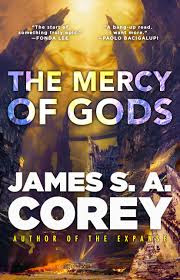
Leviathan Wakes (James Corey, an alias for two other guys). Well, it isn’t great literature; it’s a space opera. Science-fiction is my go-to escape place—I read about a dozen of these a year. This is a really good one. It’s also the basis for the hit television series, “The Expanse.” Corey is especially good at English. It isn’t high art, but it’s coherent and sometimes evocative. The writing is fine, the pacing is about right, and (surprising for lots of sci-fi) the characters jump off the page. This is the first in a series of about a dozen books. I’ve read four this past month!
Non-Fiction
Legacy of Violence: A History of the British Empire (Caroline Elkins). I grew up with maps of the British Empire (“our” territory marked in pink) hanging in my classroom. The teacher described the Empire as a noble endeavor, a civilizing force, and a bulwark against pagan religions and “bad” European powers. In fact, the British Empire, like every Empire before or since, was a violent enterprise run for the profit of a very select few, always in the national interest and never in the interest of those ruled. Elkins manages to tell this story without becoming preachy. She has a light touch in spite of the massive amount of material that she covers. Her book is especially good on the Belfour Declaration and the many ways in which Britain played a major role in messing up the Middle East today. The book is worth reading for that reason alone.
The Origins of Judaism (Yonatan Adler). Adler makes the case that some of the characteristic practices of Torah-Judaism should have left archeological and literary evidence in the record if they were practiced. So, for example, if ancient Jews didn’t eat pork, we shouldn’t find pork bones in ancient Jewish settlements. (He did). Besides pork remains, Adler examines ancient Judea’s synagogues, other dietary remains, art, tefillin and so on to determine their history in ancient Israel’s life. He concludes that there is very little evidence in the archeological record for anything like Judaism defined as awareness of and respect for the Torah until the second century BC, during the Hasmonean era. Loved it. Clarity, depth of scholarship, wide research--it's all here.

Yahweh Before Israel (Daniel Fleming) and The Origin and Character of God (Theodore Lewis). There is a lot of ferment in contemporary studies of the history of ancient Judah, Israel, and Canaan. A lot of it centers on the question, “What is the history of contemporary Judaism’s Yahweh?”
The emerging consensus is that he was a Canaanite god (maybe from the South, maybe from the foothills in the North-East) who was worshipped as one of many such gods. But sometime late in Judah’s monarchy, Yahweh was adopted as Judah’s “special” god (among the many others). And after the exile, this adoption slowly evolved into the monotheistic religions of today. Certainly not the Evangelical take! Companion books to Adler’s (see above). Compelling, probably right, and to the degree it is, the occasion to rethink modern monotheisms, including their plausibility, from the bottom up.
The Crucible of Faith: The Ancient Revolution that Made Our Modern Religious World (Philip Jenkins). Jenkins is almost always gold. This examination of what we used to call the Inter-testamentary era is a fascinating look at the diverse movements, scriptures, and people who made both modern Judaism and Christianity, in all their current and past variants, what they are today.
A bit dense at the beginning as he lays out his argument and main players, but it gets more and more interesting as the book winds to its end. I wish I had something like this to read while I was in seminary! We’ve come a long way since John Bright.
How God Becomes Real (T.M. Luhrman). In the past, I've written articles for Christian Century, The Banner, and a Christianity Today blog that argued one cannot have a personal relationship with God or Jesus--at least not in the common grammatical sense of such words. We can't share a glass of wine, or phone or email God, and then expect a similar response. We can't go to a church and hear Jesus preach and then ask questions after. We can’t shake hands.
People responded to these articles not by arguing the logic, but by describing their experiences of a personal relationships with the divine. In this book, Luhrmann explains the social practices, the settings, the psychology, the spiritual kindling and attunement that allows people to put their trust in these experiences regardless of whether or not there really is a god in that relationship.
Whether or not you think you can have a personal relationship with God or Jesus, describing that relationship from below, as Luhrman does, makes any pastor a wiser, more thoughtful spiritual leader.
Bonus Book (for Tweeners and Younger)
Space Boy (Stephen McCranie). I read this graphic novel aloud with my eight-year-old grandson. It's not anime, though influenced by it, I think. He loved it.
I appreciated how it wasn't about battles and death. No rough language. It’s a story about a girl's emotions and trials as she tries to fit into earth culture after moving to earth from a galaxy far away.
She misses her old friends. She is lonely. She wants to fit in. She meets people, makes her way, becomes aware of how her preconceptions about earth culture were wrong. She shows empathy for people who, like her, don't seem to fit in.
The tension in the book is real, keeps you on the edge of your seat, but doesn't overwhelm. It's a great opportunity to talk with about issues of friendship, loneliness, beauty, adventure, and otherness. The drawings are well done--cartoonish with a realistic bent. If you want to talk with your Tween about stuff that matters, try this!

 Make sure to read the big reveal about my book at the end of this post!